



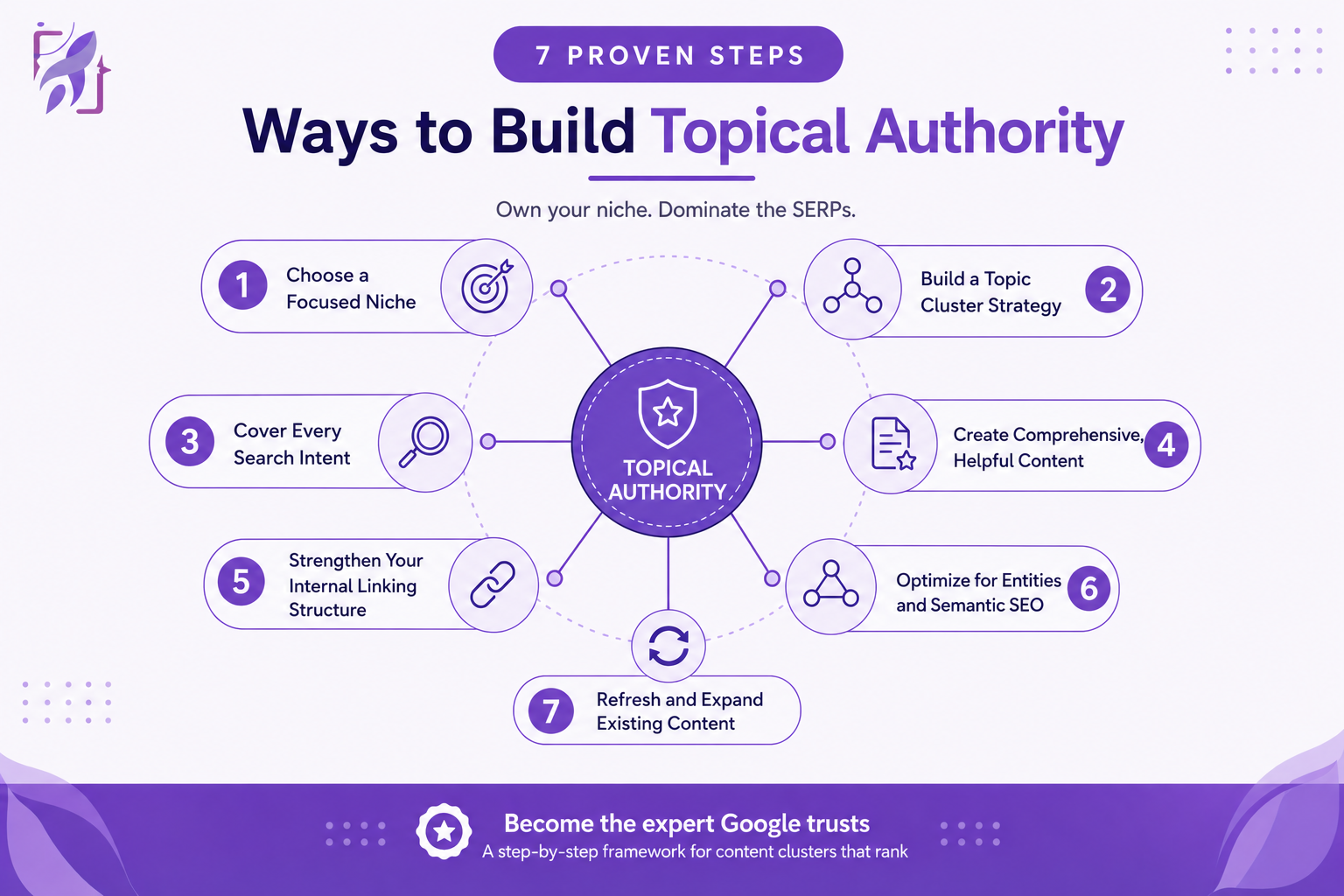
7 Ways to Build Topical Authority
Ranking on Google today requires far more than targeting individual keywords or publishing large volumes of content. Modern search engines use artificial intelligence, semantic search, and natural language processing to evaluate how thoroughly your website covers a topic and whether it provides genuine value to users.
This is where topical authority becomes essential. By creating comprehensive, interconnected, and experience-driven content around a specific subject, you signal expertise and build trust with both search engines and readers.
In this blog, you’ll discover the 7 Ways to Build Topical Authority, why it matters for modern SEO, how Google evaluates it, and the proven method you can use to achieve higher rankings, greater visibility in AI-powered search results, and long-term natural traffic.
What Is Topical Authority?
Topical authority is a search engine’s recognition of a website as a trusted expert on a specific subject. Rather than judging pages separately, Google looks at how completely your site covers a topic through helpful, connected content.
Building topical authority is not about publishing more content; it is about publishing the right content that satisfies search intent and positions your website as the go-to resource in your niche for long-term organic growth and stronger brand recognition across your industry.
Why Is Topical Authority Important for SEO?
Search engines want to recommend the most helpful and trustworthy resources.
When your website consistently demonstrates expertise across an entire topic, Google gains confidence in recommending your content to users.
That’s why implementing the 7 Ways to Build Topical Authority can significantly improve your website’s long-term search performance.
Best Ways to Build Topical Authority
The 7 Ways to Build Topical Authority go beyond publishing informational content. To establish real authority, create content that supports every stage of the user’s journey.
1. Choose a Focused Niche
The first step is selecting a clear niche. Trying to cover every topic makes it difficult for Google to recognize your expertise.
Choose one core subject that aligns with your business, audience, and long-term goals.
For example:
- Digital Marketing
- SEO
- Personal Finance
- Fitness
Once you’ve identified your niche:
- Understand your target audience’s challenges.
- Research their common questions.
- Define clear content objectives.
Starting with a focused niche makes it easier to build authority before expanding into related topics.
2. Build a Topic Cluster Strategy
One of the most effective 7 ways to build topical authority is using topic clusters.
A topic cluster consists of one comprehensive pillar page supported by multiple related articles.
For example:
Pillar Page:
- Complete Guide to SEO
Supporting Articles:
- Keyword Research
- Technical SEO
- On-Page SEO
- Off-Page SEO
Each supporting article links back to the pillar page, while the pillar page links to every supporting article. This structure helps Google understand the relationship between your content and strengthens your site’s authority.
3. Cover Every Search Intent
Many websites focus only on informational content. To build true topical authority, you need content for every stage of the user’s journey.
Create content that addresses:
Answer educational questions and explain key concepts.
Examples:
- What is Topical Authority?
- What Is Semantic SEO?
- How Does Google Rank Content?
Commercial Investigation
Help users compare options before making a decision.
Examples:
- Best SEO Tools
- Ahrefs vs. SEMrush
- Top Content Optimization Platforms
Comparison Guides
Create side-by-side comparisons to support purchasing decisions.
Examples:
- WordPress vs. Webflow
- Yoast SEO vs. Rank Math
Transactional Content
Target users ready to take action.
Examples:
- SEO Services
- Book an SEO Consultation
- Buy SEO Courses
Frequently Asked Questions
FAQ sections improve user experience and increase your chances of appearing in featured snippets and AI-generated search results.
4. Create Comprehensive, Helpful Content
High-quality content is the foundation of topical authority.
Instead of writing short articles that barely answer a question, create content that becomes the best available resource on the topic.
Your content should:
- Answer every important question.
- Include practical examples.
- Share original insights and experiences.
- Support claims with credible statistics.
- Reference trusted industry sources.
- Use visuals, tables, and checklists where helpful.
- Maintain clear formatting with descriptive headings.
The more valuable your content is, the more likely users will stay on your site, share your articles, and return for additional information.
5. Strengthen Your Internal Linking Structure
Internal linking helps distribute authority across your website while improving navigation.
Follow these best practices:
- Link related articles naturally.
- Connect every cluster page to its pillar page.
- Use descriptive anchor text.
- Update internal links whenever you publish new content.
- Identify and fix orphan pages that receive no internal links.
A strong internal linking strategy improves crawlability and reinforces the relationships between your content.
6. Optimize for Entities and Semantic SEO
To strengthen semantic SEO:
- Mention related entities and concepts.
- Cover important subtopics in depth.
- Answer follow-up questions users may have.
- Add structured data using schema markup.
- Write in natural language optimized for AI search.
This helps search engines better understand your content and improves its relevance for a wider range of searches
7. Refresh and Expand Existing Content
Publishing new content is important, but maintaining your existing content is equally valuable for implementing the 7 Ways to Build Topical Authority.
Regularly audit your website and:
- Update outdated information.
- Add new examples and statistics.
- Improve readability and formatting.
- Expand thin articles with additional insights.
Refreshing older content keeps your website relevant and signals to Google that you’re committed to providing accurate, up-to-date information.
Common Mistakes That Hurt Topical Authority
- Publishing random content without focusing on a specific niche or core topic.
- Targeting keywords instead of topics, resulting in disconnected and shallow content.
- Ignoring search intent, causing your content to miss what users are actually looking for.
- Creating thin or low-quality content that lacks depth, originality, or value.
- Neglecting internal linking, making it difficult for search engines to understand your content relationships.
- Failing to cover related subtopics, leaving gaps in your topical coverage.
How to Measure Your Topical Authority
Measure topical authority by tracking rankings, traffic, engagement, and coverage to identify gaps, improve relevance, and strengthen your strategy continuously as part of the 7 Ways to Build Topical Authority.
- Monitor Keyword Rankings: Track how many related keywords your pages rank for and whether your rankings improve over time.
- Analyze Organic Traffic: Measure the growth of organic visitors to your topic cluster using tools like Google Analytics.
- Review Google Search Console Performance: Monitor impressions, clicks, click-through rate (CTR), and average position for your content.
- Evaluate Topic Cluster Coverage: Ensure you’ve created comprehensive content that covers your main topic and all relevant subtopics.
Conclusion
Building topical authority isn’t about publishing the most content; it’s about publishing the most helpful, comprehensive, and well-connected content within your niche.
As Google continues to prioritize expertise, user intent, and semantic understanding, implementing the 7 Ways to Build Topical Authority can help your website demonstrate deep knowledge across an entire subject. This increases your chances of earning higher rankings, greater visibility in traditional search results, and stronger performance in AI-powered search experiences.
Frequently Asked Question
What is topical authority in SEO?
Topical authority in SEO is the trust and expertise a website builds by publishing comprehensive, high-quality content covering an entire subject consistently.
How to increase domain authority quickly?
Increase domain authority by publishing high-quality content, earning authoritative backlinks, improving technical SEO, building topical authority, enhancing user experience, and maintaining consistent updates.
7 ways to build topical authority with examples?
Build topical authority by creating topic clusters, publishing in-depth guides, updating content, using internal links, adding schema, covering related topics, and demonstrating expertise.