


How Businesses Use SWOT Analysis for Strategic Decisions
Businesses make strategic decisions every day, from entering new markets and launching products to investing in technology and responding to competitors. These decisions are more effective when businesses first understand their current position and the factors that may influence future performance. This is where SWOT analysis for strategic decisions can help.
SWOT analysis examines four key areas: strengths, weaknesses, opportunities, and threats. Strengths and weaknesses focus on internal factors, while opportunities and threats come from the external environment. I find this framework useful because it provides a clear and organized way to evaluate a business’s situation.
SWOT analysis can identify what a business does well, where it needs improvement, what opportunities it can pursue, and which threats it should prepare for. These can be in place and then help businesses compare method options and turn analysis into practical actions.
What Is SWOT Analysis?
A SWOT analysis is a planning tool that helps a business or person look at internal and external factors to make better choices. I find it useful because it provides a simple framework for examining various internal and external factors that can affect a business.
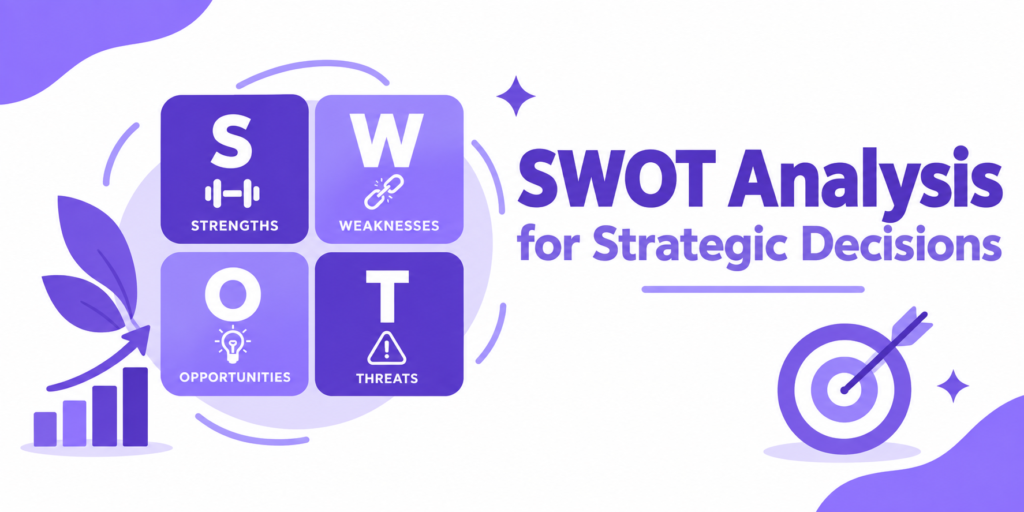
SWOT stands for Strengths, Weaknesses, Opportunities, and Threats. Strengths and weaknesses are internal factors, like resources, skills, or areas that need improvements.
Opportunities and threats are external factors, such as market trends, competitors, or economic changes. By looking at all four areas together, businesses can identify their advantages, recognize potential challenges, and make more informed strategic choices based on their goals and available resources.
Understanding the Four Parts of SWOT Analysis
I examine Strengths, weaknesses, Opportunities, and Threats to understand a business’s position, identify challenges, and find strategic opportunities.
Strengths: Strengths are the internal qualities that give a business an advantage. These may involve skilled employees, strong customer relationships, financial stability, and a strong reputation. Valuable resources or innovative products. These benefits help the company understand what it can really do when developing a method.
Weaknesses: Weaknesses are internal limitations that may reduce a company’s ability to achieve its goals. These could involve outdated systems, limited funding, poor customer service, or problems retaining employees. Recognizing these areas allows businesses to focus on improvements and reduce potential disadvantages.
Opportunities: Opportunities are external situations that a business can use to support a powerful market position. Changes in customer preferences, emerging technologies, new markets, partnerships, or industry trends can make opportunities for expansion and increased revenue.
Threats: External challenges or risks that could negatively impact a business’s success. These uncontrollable market variations require early planning and risk mitigation changes in customer preferences, stronger economic uncertainty, new daily rising costs, or supply disruptions to prepare answers, protect resources, and make content method decisions.
How Businesses Use SWOT Analysis for Strategic Decisions
The main purpose of SWOT is to help businesses move from information to action. In place of simply listing various internal and external decision markers, they can use those findings to evaluate where the company’s focus is on its resources.
Identify Growth Opportunities
SWOT analysis for strategic decisions can help a company examine if an opportunity fits their existing capabilities. A market may appear attractive, but that does not necessarily mean the company is prepared to enter it
Decision-makers can compare the opportunity with their strengths, weaknesses, available resources, and competitive position. If a business has a strong brand and effective online sales but lacks local market knowledge, it may need a local partner before expanding.
This approach helps businesses distinguish between attractive opportunities and opportunities they can realistically pursue.
Address Business Weaknesses
Weaknesses can influence strategic priorities. If a company identifies a capability gap that could prevent successful growth, management can decide whether to improve that area before moving forward.
For example, a business planning to introduce a new digital marketing agency may discover that its existing technology infrastructure cannot support the expected demand. Instead of immediately launching the service, it could invest in upgrading its systems.
In this way, SWOT analysis for strategic decisions can help businesses identify where resources may have the greatest strategic value.
Prepare for Potential Threats
External threats can also shape strategic planning. Businesses can use SWOT findings to identify risks and consider ways to reduce their potential impact.
If a company relies heavily on one supplier, for example, supply-chain disruption could become a significant threat. Management might respond by finding alternative suppliers or increasing inventory for critical products.
The goal of SWOT analysis for strategic decisions is not to predict every possible problem. In place, businesses should identify the most important threats and develop practical responses before they become serious obstacles.
Compare and Prioritize Strategic Options
Businesses often have several possible courses of action. SWOT can help decision-makers compare these options using the same set of internal and external factors.
Rather than asking only, “Which opportunity looks most attractive?” management can ask whether the company has the strengths needed to pursue it, what weaknesses could create problems, what external opportunities support it, and which threats could reduce its chances of success.
This makes SWOT analysis for strategic decisions more useful than simply creating an unstructured list of business factors.
Benefits of Using SWOT Analysis for Strategic Decisions
SWOT analysis for strategic decisions helps businesses make informed decisions, identify risks, use resources effectively, strengthen competitive benefits, and align teams with method goals
- Supports Better Decisions: It organizes complex information into four clear areas, making it easier to evaluate options and choose the right strategy.
- Strengthens Competitive Position: It identifies the qualities and capabilities that give a business an advantage over its competitors.
- Helps Identify Risks Early: It reveals potential threats and weaknesses, allowing businesses to address challenges before they become serious issues.
- Improves Resource Planning: It helps businesses determine where to focus their time, budget, and workforce to achieve strategic goals.
- Promotes Team Alignment: It encourages employees and leaders to share perspectives, discuss challenges, and work together toward practical solutions.
How to Make SWOT Analysis More Effective
Businesses can make their SWOT analysis more effective by following several important practices. First, they should define a clear method objective by focusing on a specific decision, like entering a new market or launching a product. They should also involve reliable information, including customer feedback and financial data, and market research and performance measures.
Involve employees from different departments to provide diverse perspectives and reveal factors that might otherwise be overlooked. This approach can make SWOT analysis for strategic decisions more accurate and useful.
Businesses should focus on the most important issues rather than including unnecessary details, allowing decision-makers to identify key priorities and turn SWOT findings into effective strategic actions.
Conclusion
SWOT analysis can help businesses understand their current position, evaluate opportunities, recognize weaknesses, and prepare for external threats. As its real value comes from what company do with the findings.
A useful analysis connects internal capabilities with external conditions and helps decision-makers compare realistic strategic options. By matching strengths with opportunities, addressing weaknesses, and preparing for threats, businesses can turn a simple framework into a practical planning tool.
Ultimately, SWOT analysis for strategic decisions is most valuable when it helps a business move beyond identifying strengths, weaknesses, opportunities, and threats and use those insights to choose specific, measurable strategic actions.
Frequently Asked Question
Describe how businesses use SWOT analysis for strategic decisions
Businesses use SWOT analysis for strategic decisions by evaluating strengths, weaknesses, opportunities, and threats to compare options, reduce risks, and choose effective strategies.
SWOT analysis of a company example
A SWOT analysis of a company examines its strengths, weaknesses, opportunities, and threats to understand its position and support effective strategic decisions.
What is the SWOT analysis used for in strategic management?
SWOT analysis is used in strategic management to evaluate internal strengths and weaknesses, identify external opportunities and threats, reduce risks, and support informed decisions