



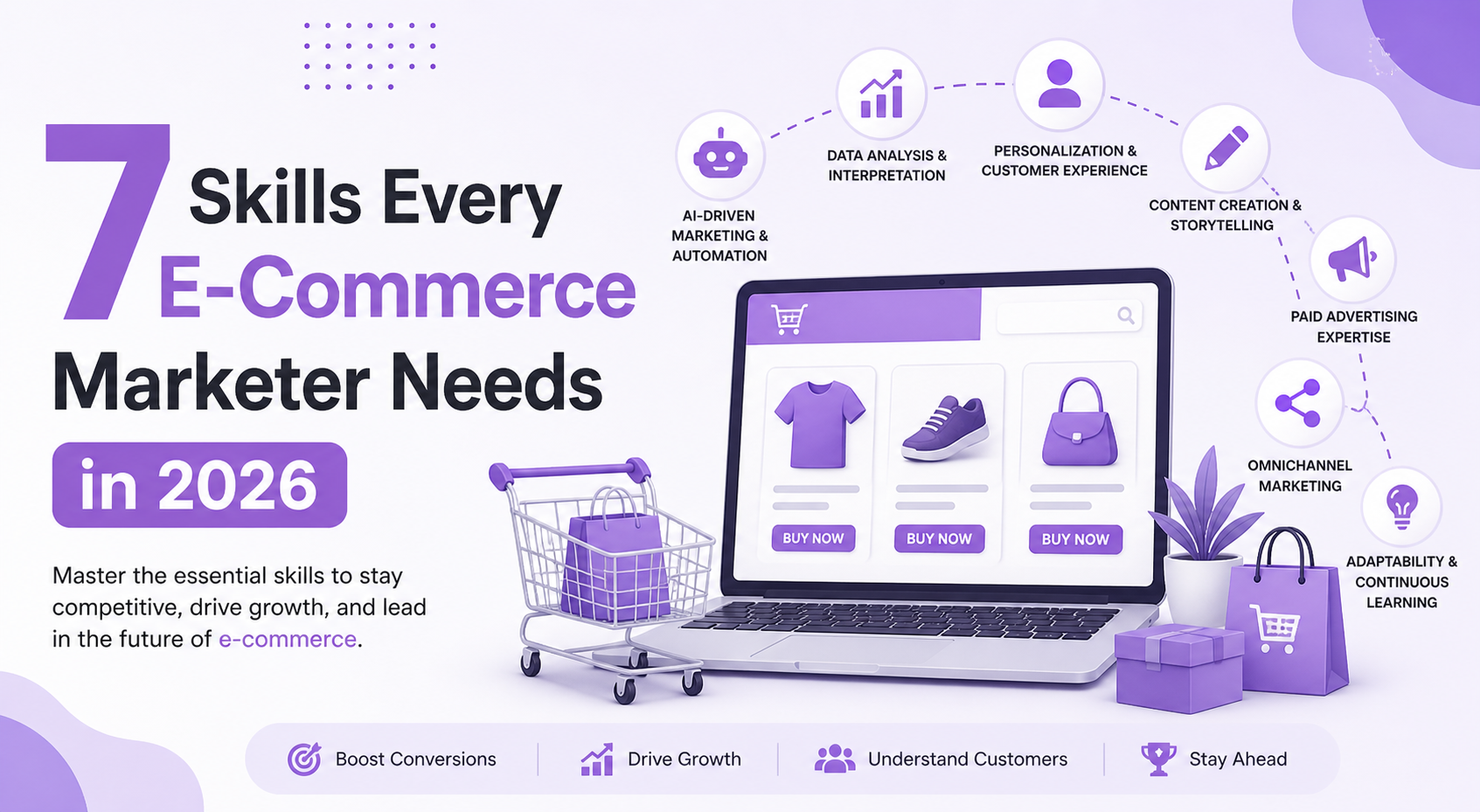
7 Skills Every E-Commerce Marketer Needs in 2026
The e-commerce world is changing at a pace that feels almost stressful. If you’ve been working in this field, you’ve probably noticed how faster trends shift what worked last year may already feel outdated today. I’ve personally experienced advertising that once performed incredibly well suddenly lose traction, not because the product changed, but because consumer behavior did.
That’s why understanding the e-commerce skills for 2026 is more than just staying updated; it’s about staying same. In case you’re a learner or someone already deep into e-commerce, these skills will help you navigate the future with confidence.
Let’s explore the 7 essential skills that will define successful e-commerce marketers in 2026
AI-Driven Marketing and Automation
Artificial Intelligence is no longer elective; it’s a need In 2026, marketers who know how to harness AI will have a major advantage one of the most important e-commerce skills for 2026 is how to use AI effectively.
From automating emails to generating product descriptions and studying people behavior, AI tools can save time and improve efficiency. I remember spending hours writing product descriptions naturally. Now, AI tools can make drafts in seconds but the real skill lies in improving them to match your brand voice.
What to focus on:
- AI-based content generation
- Automated customer journeys
- Chatbots for instant support
- Predictive analytics
The key is balance use AI to scale, but keep the human touch alive.
Data Analysis and Interpretation
Data is everywhere, but not everyone knows how to use it skillfully. One of the most valuable e-commerce skills for 2026 is the ability to turn raw data into useful insights.
Early in my journey, I used to follow too many various metrics without learning their importance. With time, I realized that focusing on the right numbers makes all the difference.
Key metrics to understand:
- Conversion rates
- Customer acquisition cost (CAC)
- Customer lifetime value (CLV)
- Return on ad spend (ROAS)
When you understand your data, you make smarter decisions—and that directly impacts profitability.
Personalization and Customer Experience
Customers in 2026 expect brands to understand them. Generic messaging simply doesn’t work anymore, making personalization a key part of e-commerce skills for 2026.
Think about how you shop online. When a website suggested products that match your interests, it feels seamless. That’s the power of personalization.
Important elements:
- Personalized email campaigns
- Product recommendations
- Behavioral targeting
- Customized offers
From my experience, even small personalization efforts can significantly boost conversions. People are more likely to buy when they feel understood.
Content Creation and Storytelling
Content is everywhere, but meaningful content is rare. Strong storytelling is one of the most underrated e-commerce skills for 2026.
I’ve seen small businesses outperform large market level simply because they connected better with their audience. They didn’t just sell products; they shared their journey.
Content strategies to master:
- Short-form videos
- User-generated content (UGC)
- Educational posts
- Behind-the-scenes storytelling
In 2026, authenticity matters more than perfection. People trust brands that feel real.
Paid Advertising Expertise
Natural reach is becominore limited, making paid advertising performance one of the most technical e-commerce skills for 2026.
Running ads isn’t just about spending money—it’s about spending it wisely. I’ve learned that even a small tweak in ad creatives or targeting can completely change results.
What to learn:g m
- Ad creative testing
- Audience targeting
- Retargeting strategies
- Budget optimization
If you can consistently create high-performing ads, scaling your business becomes much easier.
Omnichannel Marketing
Customers interact with brands across multiple platforms, and their journey isn’t always straightforward.
They might discover your product on social media, read reviews on your website, and complete the purchase on a marketplace. This is why omnichannel marketing is one of the most important e-commerce skills for 2026
Channels to integrate:
- Social media
- Email marketing
- SMS campaigns
- Online marketplaces
The goal is to provide a seamless experience across all touchpoints.
Adaptability and Continuous Learning
If there’s one skill that ties everything together, it’s adaptability.
e-commerce skills for 2026 is constantly evolving. Algorithms change, new platforms emerge, and customer preferences shift. I’ve had to adjust my strategies multiple times, and each time it taught me something new.
How to stay ahead:
- Keep learning new tools
- Stay updated with trends
- Experiment with strategies
- Learn from failures
The more adaptable you are, the easier it becomes to succeed in this fast-changing industry.
Final Thoughts
Learning the e-commerce skills for 2026 isn’t about doing everything at once—it’s about growing step by step.
From my personal skills, the most successful marketers are not the ones who know everything, but the ones who are willing to learn and adapt. Focus on building these skills slowly and you’ll see long-term results.
E-commerce isn’t slowing down anytime soon. If anything, it’s becoming more competitive. But with the right e-commerce skills for 2026 you won’t just keep up—you’ll lead.
Frequently Asked Questions
What are the most important e-commerce skills for 2026?
The most important e-commerce skills for 2026 include AI-driven marketing, data analysis, personalization, content creation, paid advertising, omnichannel marketing, and adaptability. These skills help marketers stay competitive in a rapidly evolving digital landscape.
Why is AI important in ecommerce marketing?
AI helps automate repetitive tasks, analyze customer behavior, and improve marketing efficiency. It allows marketers to focus more on strategy and creativity while saving time.
How can I improve my e-commerce marketing skills?
You can improve your ecommerce skills by practicing regularly, analyzing data, experimenting with campaigns, and staying updated with industry trends. Learning from real-world experience is key.